Quality Control Checkpoints in Custom Fragrance Production
Quality in fragrance production is not a final inspection. It is a sequence of checkpoints, each with an owner, a measurement and a record, and it fails at the earliest point where one of those three is missing. A brand that asks to see the checkpoints learns considerably more about a manufacturer than one that asks to see a certificate.
Key takeaways
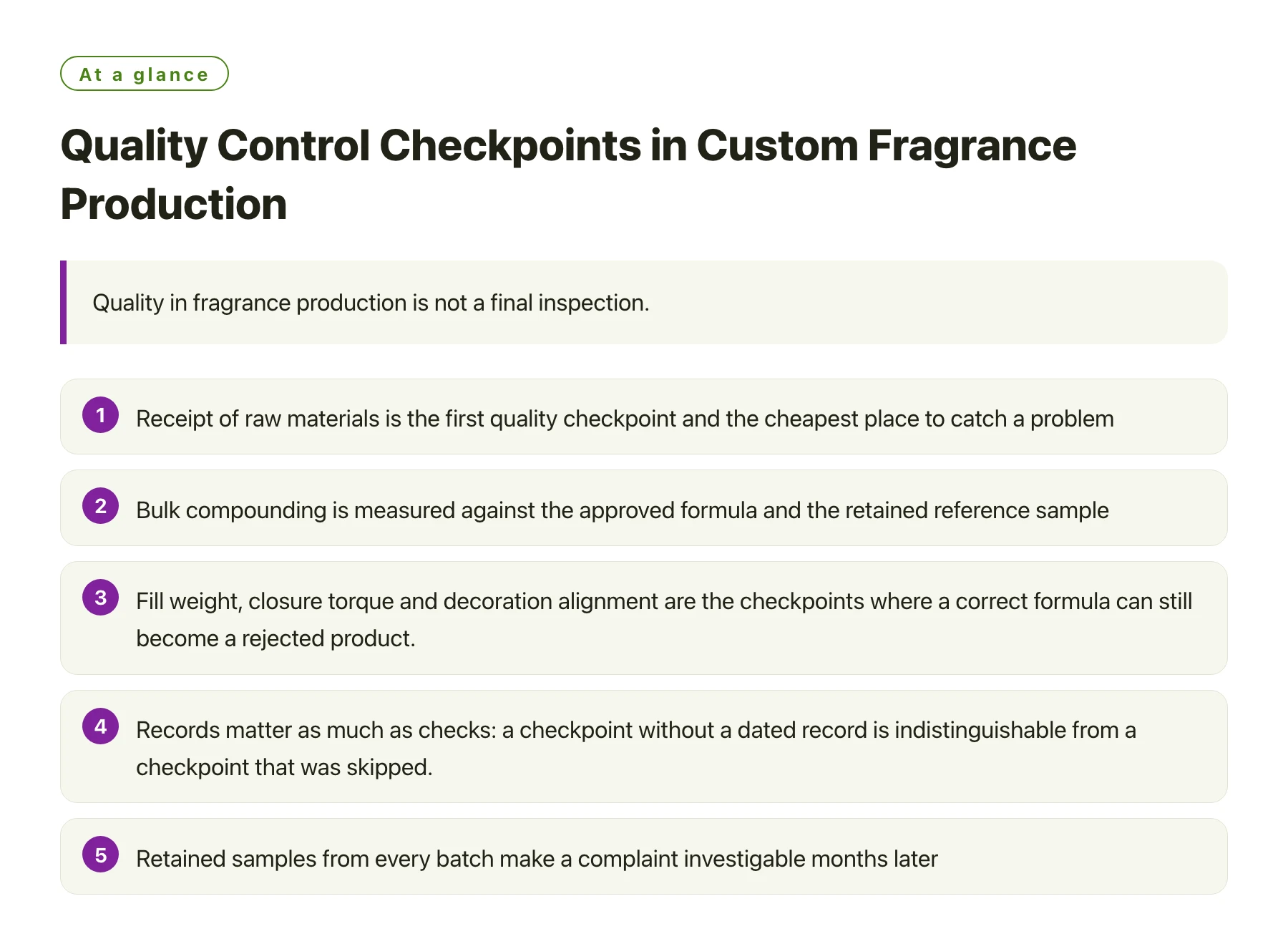
- Receipt of raw materials is the first quality checkpoint and the cheapest place to catch a problem, because nothing has been committed to a batch yet.
- Bulk compounding is measured against the approved formula and the retained reference sample, not against a description of the scent.
- Fill weight, closure torque and decoration alignment are the checkpoints where a correct formula can still become a rejected product.
- Records matter as much as checks: a checkpoint without a dated record is indistinguishable from a checkpoint that was skipped.
- Retained samples from every batch make a complaint investigable months later, which is when most quality questions actually arrive.
This is written for a brand that is about to run a first or second production order and wants to know which points in the process to look at. It is deliberately specific, because quality conversations become vague exactly when they should become technical.
The order below follows the physical flow of material through the plant. Not every manufacturer will use the same names, but the sequence is close to universal.
The checkpoints, in production order
| Checkpoint | What is being checked | The record it should leave |
|---|---|---|
| Raw material receipt | Identity, supplier certificate of analysis, condition on arrival, batch number captured | Goods-in record linked to the material batch |
| Weighing and dispensing | Each material weighed to the specified tolerance against the formula | Signed weighing sheet with actual values |
| Bulk compounding | Order of addition, mixing time and temperature, appearance and odour against the reference | Compounding record with a retained bulk sample |
| Maceration or resting | Held for the specified period under the specified conditions where the product requires it | Time and temperature log |
| Filling | Fill weight or volume within tolerance, no leakage, correct container | In-process fill checks across the run |
| Assembly and closure | Closure torque or crimp, pump function, alignment of any decoration | Assembly inspection record |
| Finished goods release | Appearance, labelling, pack contents and comparison with the retained reference | Release note signed against the specification |
| Retention | A sealed sample from the batch held for the retention period | Retained sample register with location |
A manufacturer running to a cosmetics GMP framework will already generate most of these records as a condition of the system, since traceability from raw material to release is the purpose of that framework [1]. What a brand should test is whether they are produced on every run, not only on audit day. Where the product sits at the top of the market, the tolerance expectations tighten further, which is why quality control in luxury fragrance production tends to be a separate conversation from standard production control.
Where fragrance quality control differs from general cosmetics QC
Fragrance inherits the standard cosmetic control framework, then adds three complications of its own. All three affect what a brand should ask to see.
The reference is sensory as well as analytical
Fill weight can be measured to the gram; a scent cannot. That is why the retained reference sample carries so much weight in fragrance production. Release decisions are made by comparing a bulk sample with the approved reference, which makes the reference object the most important piece of quality equipment in the room.
It also means the reference has to age the way the production stock ages. A reference kept in a warm office stops being a reference. Ask where retained samples are stored and for how long.
Restricted materials have to be controlled at the point of use
Fragrance materials are subject to use limits that depend on the product category, and those limits are the reason the formula is checked against the IFRA Standards before production rather than after [2]. At the plant, the practical control is the weighed quantity of the compound in the batch and, where relevant, the specification of the compound supplied. A manufacturer that cannot show how it controls addition rates is not controlling the limit.
Degradation is a time-dependent failure
Colour shift, viscosity change and odour drift often appear weeks after filling, not at release. This is why stability testing sits upstream of production and why retention samples matter downstream: without them, a complaint three months later cannot be traced to a batch condition or ruled out.
How to audit the checkpoints on a first order
- Ask for the release specificationBefore the order, request the document that defines what acceptable looks like at each checkpoint, including tolerances. If it does not exist, the checks are informal.
- Follow one batch record end to endPick a recent run and walk it from goods-in to release. Look for actual measured values rather than ticks, because ticks can be added retrospectively.
- Inspect the retained samplesAsk to see where retention samples are stored, how they are labelled, and how a sample from an older batch can be retrieved. Then ask for one.
- Watch a fill checkIn-process fill control is the checkpoint most often described rather than performed. Ask what the sampling frequency is and what happens when a reading drifts.
- Define your own incoming checkDecide what the brand will verify on receipt - appearance, fill level, labelling, pack integrity - and who signs it off. That record is your half of the traceability chain.
One question separates a functioning quality system from a documented one: what happened the last time a batch failed a checkpoint? A manufacturer with a working system will describe the batch, the reason, the disposition and the corrective action. A manufacturer with a certificate and no story to tell usually has a system that exists for the auditor.
What to do when a checkpoint fails
The response should be proportional and documented. A fill-weight drift is corrected on the line and recorded. A compounding error is investigated, and the disposition of the affected bulk is decided before filling continues. A release failure after filling is the expensive case, because the value already sits in decorated packs.
Ask in advance how each of those three is handled, and who decides. The useful answer names a person and a document rather than a policy. It also helps to agree what happens to the cost of a failed batch, and whether rework or replacement carries a charge. That term belongs in the commercial agreement, not in a conversation after the event.
For a brand running several products, it is worth knowing how a manufacturer structures quality across categories, because controls differ between a fine fragrance and a body product. Public material such as Xuelei's website is a reasonable way to see how a company describes its production scope before you send a quality questionnaire.
One further point belongs here. Quality control at a contract manufacturer covers what the manufacturer makes, so the boundary matters. Where filling, decoration and assembly are subcontracted, the checkpoints travel with the work, and the records should too. A brand using Xuelei as a single point of accountability gains something real: one release document, one retained sample, one party to call when a batch does not match.
Sources
- SGS: Cosmetics, Personal Care & Household Testing —— Testing, inspection and certification services for cosmetics and personal care, including microbiological, stability and safety testing aligned with cosmetics GMP.
- IFRA: Safe Use and Fragrance Science —— IFRA's explanation of how fragrance materials are scientifically assessed for safe use and how those conclusions are applied by the industry.
Frequently asked questions
What is the most important quality checkpoint in fragrance production?
Bulk compounding against the retained reference, because everything downstream inherits that decision. Raw material receipt runs it close, since a problem caught there has not yet been paid for in production time.
Do we need to visit the factory to audit quality?
Not necessarily, but you should review a complete batch record and inspect retained samples. A walkthrough of one real record answers most questions that a tour would not.
How long should retained samples be kept?
Long enough to cover the product's shelf life plus a margin, so that a complaint can be investigated. Ask for the retention period in writing and for the storage conditions.
What should the brand check on receipt of goods?
Appearance, fill level, labelling accuracy, decoration alignment and pack integrity, with a dated record. It is quick, and it completes the chain of traceability that starts at the factory.
What if a batch clearly fails before filling?
The bulk should be quarantined and a disposition decision recorded before filling resumes. Ask in advance who makes that call and how rework or replacement is charged.