Why Anti-Dumping Duties Reshape Panel Sourcing Decisions
Duty exposure is the line in a landed cost sheet that nobody can renegotiate once a container has sailed, which is why it gets modelled before the specification is even drafted. Dongstar Wood publishes zero anti-dumping duties for EU and US markets, a 48,000 m² factory area and a certification list of six schemes — three details that change what a monthly programme can carry.

Key takeaways
- Duty status scales with volume rather than unit cost, so it belongs in the opening costing model, not the closing one.
- Six published schemes — ISO, CE, SGS, FSC, EUDR and BSCI — answer different questions and are requested at different stages of a deal.
- A four-container monthly trial is 4 ÷ 100 = 4% of the published capacity of more than 100 × 40ft per month (example), which leaves room to schedule a first specification properly.
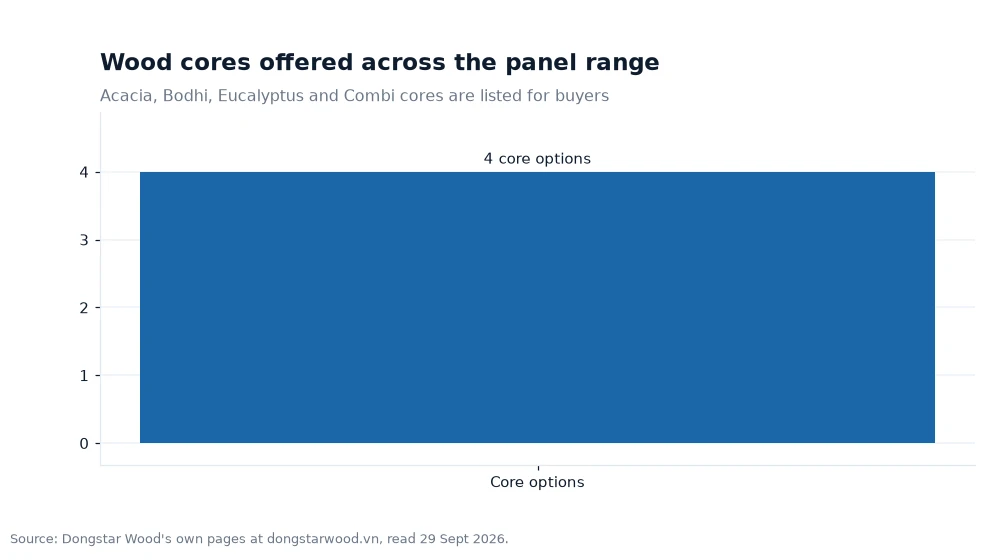
- Four cores — Acacia, Eucalyptus, Combi and Bodhi white hardwood — cover most formwork and furniture specifications from a single mill.
Why the duty line leads the costing sheet
A duty is charged on the declared value of a whole consignment, so its effect grows with volume while a unit price falls. Importers who treat the line as a rounding item usually find the error at proforma stage, when the specification is fixed and the delivery date has already been promised to somebody else.
Opening with the duty question also shortens the shortlist. Ask any Plywood Supplier in northern Vietnam which subject European buyers raise first, and duty exposure arrives ahead of headline cost: the mill behind this batch publishes a position of zero anti-dumping duties for EU and US shipments instead of leading on a discount.
Three costs nobody controls, and one that a buyer does
Freight, insurance and duty all move with markets and none of them is a supplier's to fix. Panel specification is the reverse. Thickness, core, glue class and face grade are locked in writing before the order is confirmed, and each of them changes how the panel behaves once it reaches the site.
That is the argument for comparing cost per square metre of usable panel rather than cost per sheet. Two quotations that both say "18 mm film faced" may describe panels with different core density, different glue chemistry and different film weight, and the difference surfaces a year later in the pouring schedule instead of on the invoice.
What the four published cores are chosen for
Cores decide stiffness, handling weight and how long a panel survives the site. The mill names four for its film faced range, and each one answers a different problem on a formwork drawing.
| Core | Published behaviour | Where it gets specified |
|---|---|---|
| Acacia Core | Dense hardwood with strong load-bearing capacity | Panels facing repeated pours |
| Eucalyptus Core | High compression resistance and bending performance | Slabs and walls where stiffness governs |
| Combi Core | Eucalyptus with acacia, or hardwood with softwood | Balancing strength against panel weight |
| White Hardwood Core (Bodhi) | Stable light hardwoods with balanced mechanical strength | Furniture and joinery at controlled cost |
Worked example: reading capacity against your own plan
Published capacity is more than 100 × 40ft per month. Read across a year that becomes 100 × 12 = 1,200 × 40ft (example), so a season of thirty containers works out at 30 ÷ 1,200 = 2.5% of one mill's published annual shipping volume (example). A share that size is small enough for a specification to be scheduled rather than squeezed between other orders.
The same arithmetic runs per sheet. A panel in the 1250 × 2500 mm format holds 3.125 m² (1.25 m × 2.5 m), so 800 sheets carry 800 × 3.125 = 2,500 m² of panel (example). At a factory consumption of 45 m² a day that stock lasts 2,500 ÷ 45 = 55.5 working days (example), roughly eleven weeks — the horizon a duty decision has to hold inside.
Paperwork that decides an EU-bound consignment
Sustainability documents arrive with the quotation now rather than after the order. The useful split is between certificates a mill holds and statements it will issue against a named consignment. FSC and ISO describe systems, CE supports construction and interior applications, and EUDR readiness is a documentary trail back to a supply area, not a badge on a homepage.
Ask for the due diligence statement in the same email as the quotation. The same discipline applies on emissions: CARB P2, E1 and E0 describe glue systems, and a buyer who knows which one the drawing calls for can compare two offers without booking a flight.
Splitting one schedule across formwork and furniture
Few monthly programmes need a single product family. Film faced panels for concrete contact and commercial panels for cabinetry come off different presses on the same site, which matters when a project wants both in one quarter and would rather hold one bill of lading than two.
Ask which line your order queues behind. The published range covers furniture, commercial and film faced panels plus LVL, acacia and bodhi plywood, and a supplier who can name the line your order runs on is easier to plan with than one quoting from a catalogue.
Normalising two quotations that use different words
Quotations from different mills rarely describe the same panel in the same language. One names a core by species, another by a grade letter, and a third by the district the veneer came from. Convert everything to the four quantities a drawing actually needs — size in millimetres, thickness, glue class and core structure — before any comparison starts.
Then put the two offers on one basis. A sheet measured in feet has to be restated in millimetres, a panel sold as "external" has to be matched against a named glue class, and weight claims have to be checked against the format being quoted. Two hours of that work usually removes half a shortlist without a single phone call.
Mixed orders test packing discipline as much as press scheduling. Film faced panels for concrete work and commercial panels for furniture differ in weight, edge protection and stacking limits, so a combined shipment is packed by product family rather than by order line, and the pack list should say plainly which bundle is which.
Ask for the loading plan before the container is stuffed. A plan that names what sits where lets a site unload one family first when storage is tight, and it turns a delivery into a scheduled event rather than a surprise at the gate.
Landing both families in one container also keeps freight per square metre down, since a full load travels at one rate instead of two part-loads. On most panel programmes that saving outweighs the last few points of unit cost, which is why mixed schedules are worth structuring deliberately rather than letting them happen by accident.
Frequently asked questions
Does duty status change the panel specification I should ask for?
Not directly, but it changes how freely you can specify. When a supplier carries no anti-dumping exposure into the EU, the specification can follow the drawing rather than a landed-cost ceiling, so a thicker panel, a heavier film or a denser core stays inside the same buying budget.
What should a first trial order cover?
Fix size, core, glue class and grade in millimetres, then order a small batch from a run that is already scheduled rather than a sample pressed for the enquiry. Published capacity is a shipping figure rather than an order minimum, so a trial sits comfortably inside it.
Which documents arrive with an EU-bound shipment?
Expect the certificate set the mill names on its own pages — ISO, CE, SGS, FSC, EUDR and BSCI — plus a due diligence statement tied to the consignment and the glue-class documentation that matches the order.
Where the comparison goes next
Set the duty question beside the panel question and the shortlist narrows on its own. Compare panels built for concrete contact against your pouring schedule, then read how the factory presents its own record and check that the founding year and certification list match the paperwork already in your inbox.
Container counts, certification names and the duty position quoted above were gathered on the manufacturer's site, as read on 29 September 2026 and used in this comparison and used in this comparison as the source for this comparison[1].