A Practical Guide to Reviewing sourcing service proposals
A sourcing proposal often combines supplier access, local communication, quality coordination, and commercial support in one document. Buyers should verify what is actually delivered, who performs it, what evidence supports capability, and how fees and decisions are controlled. A consistent review helps separate a useful operating model from attractive but unmeasurable promises.
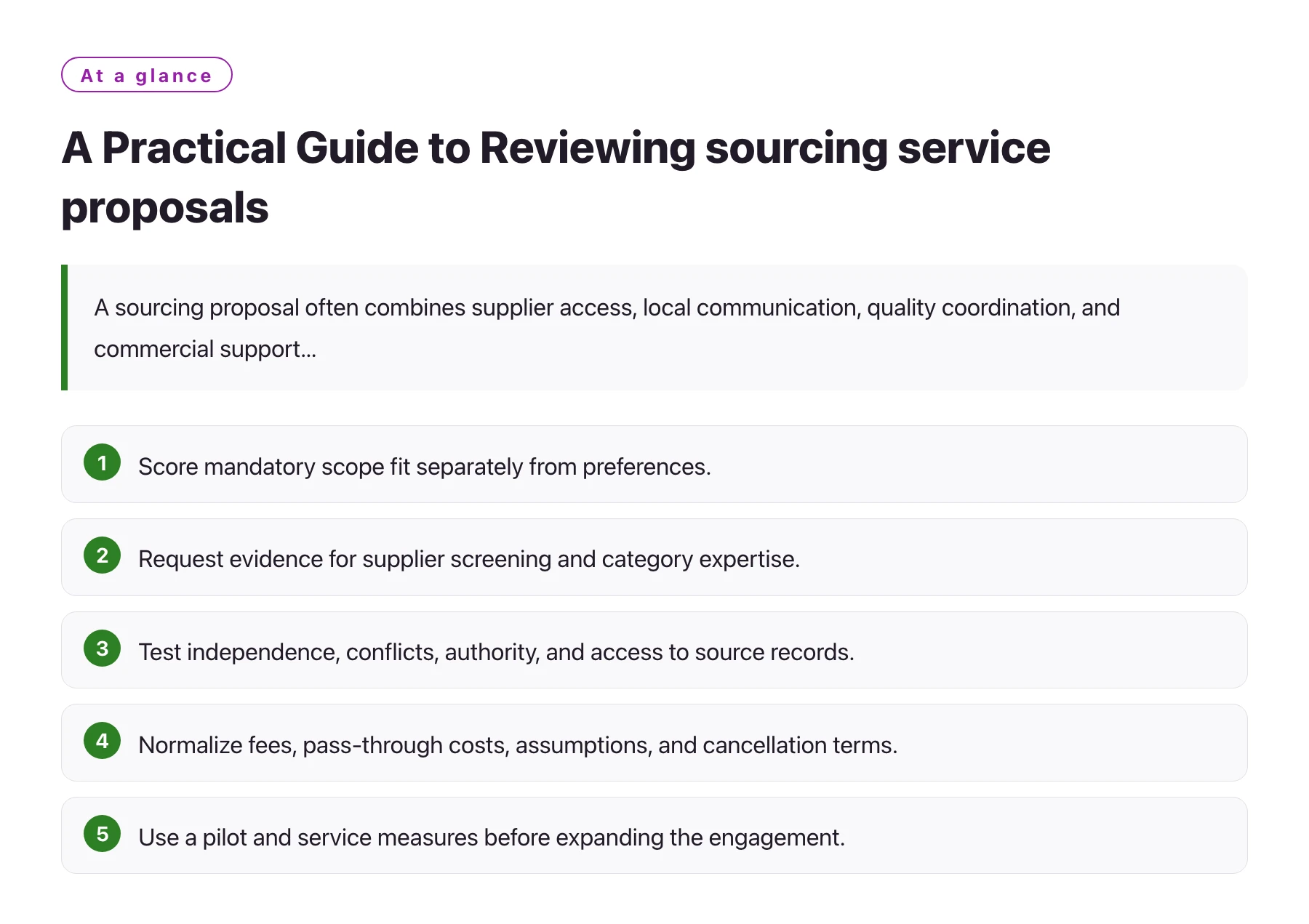
Key takeaways
- Score mandatory scope fit separately from preferences.
- Request evidence for supplier screening and category expertise.
- Test independence, conflicts, authority, and access to source records.
- Normalize fees, pass-through costs, assumptions, and cancellation terms.
- Use a pilot and service measures before expanding the engagement.
A proposal scorecard should help the buyer make a decision and expose gaps that need written clarification before award.
1. Convert the business need into review criteria
List the products, markets, order volume, schedule, internal capacity, technical risks, and expected outcomes. Rank must-have capabilities separately from preferences such as convenience or broad supplier reach. A proposal that misses a mandatory requirement should not win because it scored well on softer criteria.
Choose criteria that the provider can demonstrate or commit to: deliverables, response time, evidence completeness, named resources, escalation, and record access. Avoid vague measures such as excellent service or guaranteed savings without a defined basis.
2. Check scope against the order scenario
Use one realistic example order and map proposal tasks from supplier search through quotation, samples, production, inspection, shipment, and receipt. Mark what is included, excluded, optional, dependent on buyer input, or billed separately.
Ask the provider to identify who communicates with factories, who approves specifications, who selects inspectors, and who releases goods. If a service is described as full management, request the exact task list and decision boundaries.
3. Verify supplier-screening methods
Ask how legal identity, factory site, product capability, capacity, export history, quality records, and subcontractors are checked. Request redacted examples showing sources, dates, findings, limitations, and supplier-specific conclusions.
Distinguish directory research, phone screening, document review, site visit, audit, product test, and reference check. Each supports different claims. A proposal should not imply that one quick check verifies every risk or guarantees future delivery.
4. Evaluate category expertise and staffing
Request named roles, relevant product experience, technical knowledge, language coverage, site access, workload, and backup contacts. Ask who conducts factory visits, who interprets documents, and when specialist engineering, laboratory, or regulatory expertise is engaged.
Review capacity for peak periods and multiple open orders. Confirm whether field work or subcontracted services are included in price. A single account contact may coordinate the work but should not obscure who performs technical review or quality decisions.
5. Examine independence and incentive risks
Ask whether the provider receives referral fees, commissions, rebates, resale margin, or compensation from recommended suppliers. Clarify whether it acts as buyer agent, reseller, consultant, or another role. Identify how conflicts are disclosed and managed.
Buyers should receive original quotations or a transparent price breakdown where the service model allows it. Confirm who owns supplier relationships, samples, tooling, and records. Incentive arrangements should not quietly shape supplier recommendations or product choice.
6. Review quality and evidence controls
Determine whether the provider coordinates specifications, sample approval, inspection, testing, corrective action, and document collection. Ask who defines criteria, classifies findings, and approves concessions. Request actual report formats and examples of closed corrective actions.
ISO 9001 concerns quality management systems; certification should be verified for issuer, scope, site, and validity. It does not prove a particular supplier, product, or service outcome. Review proposal-specific procedures and evidence relevant to the buyer’s category and risk. [1]
7. Compare fees and commercial exposure
List retainer, project fees, order-value percentage, visit, travel, translation, sample shipping, inspection, laboratory, and other pass-through costs. Compare the same workload and term across proposals. Ask how repeat orders and exception-heavy situations are charged.
Review cancellation, rush work, minimum commitments, currency, taxes, payment timing, and expenses requiring approval. Model likely and high-use scenarios. A low base fee may exclude the activities that matter most when a supplier issue appears.
8. Assess data access and continuity
Define ownership and access to supplier lists, quotes, drawings, sample records, photos, inspection reports, shipment data, and communications. State confidentiality, retention, permitted reuse, and secure return or deletion. Ask whether records can be exported at any time.
Review service continuity, backup staffing, termination support, and open-order handover. The buyer should be able to continue with supplier contacts, current revisions, approval records, and actions if the provider or account lead changes.
9. Use a weighted scorecard with evidence
Score scope, supplier evidence, category skill, quality controls, independence, communication, total cost, data access, and continuity. Set weights before opening final proposals. For each score, cite a document, reference, example, or written answer and name the evaluator.
Keep unresolved risks visible outside the total score. A proposal should not pass a mandatory conflict, data-access, capability, or compliance gap just because its weighted average is high. Set a mitigation owner and due date before award.
10. Negotiate clarifications and run a pilot
Send a written list of scope, staffing, fee, decision-right, evidence, and reporting questions. Request a revised proposal that names accepted changes and preserves exclusions. Align the contract statement of work with the final proposal and service measures.
Use a pilot with a defined product and order scenario. Review actual outputs, response times, supplier transparency, issue escalation, fee variance, and buyer workload. Buyers exploring Explore options should expand only after observed delivery supports the proposal’s claims.
Sources
Frequently asked questions
Should proposal criteria be weighted before review?
Yes. Set mandatory screens and comparative weights in advance, then attach evidence for each score.
Does certification prove the sourcing provider will perform well?
No. Check certification scope, then assess the proposal’s actual tasks, staff, controls, and service evidence.
How should hidden commissions be addressed?
Require written disclosure of referral, rebate, resale, or supplier-paid incentives and assess any conflict.
What should a pilot measure?
Measure deliverable completeness, timeliness, evidence access, escalation, fees, and actual buyer effort.